
 Written by
Why would a Sensei repeat his black belt test—and not only repeat it, but attempt a much harder version? I’m still asking myself that question. But it may have to do with what the One Heart Challenge means to me.
The One Heart Challenge is demanding. It asks questions that become more meaningful the longer you practice Karate.
My earliest experience in Isshin Ryu Karate
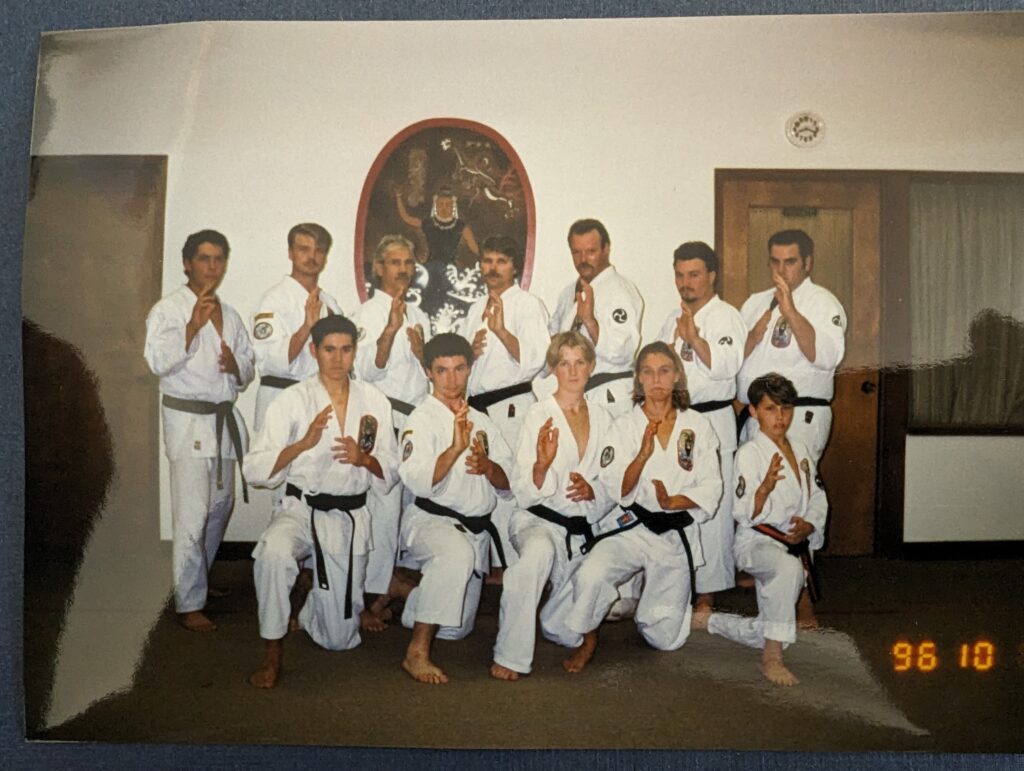
I started training in 1992 at age 12. I received my Shodan four years later in 1996. My first instructors taught Isshin Ryu the way they learned it: through endless repetitions of basics, kata, linear fighting techniques, and hard sparring. By today’s standards, their approach was militant. Everything was practiced with full speed and power. Injuries were common. Complaining wasn’t allowed. Fear and respect were treated as the same thing.
If you earned a black belt from my teachers in the 1990s, you also developed a certain attitude. They came up during what karate historians call the “blood and guts era”—the 1960s and ’70s. Most American karate instructors of that period were former Marines who fused the Marine’s Semper-Fi mentality with the karate they’d learned in Okinawa.
I still owe a lot to my teachers. I was a shy kid, frequently bullied. Their training gave me the confidence to stand up for myself. But their methods came with some baggage that’s best left in the past.
In 2005 I took what ended up being a 20-year break from Isshin Ryu Karate. I never stopped being a martial artist—I trained in Hapkido, mixed with some other styles, for 10 years. I was also certified in escrima by a historic Filipino Martial Arts club in Stockton California. But for a long time, I thought I’d never fully return to the One Heart Way. I’ve since learned to focus on the good and leave the rest where it belongs.
A different standard
The One Heart Challenge occupies a rare space. It shows how to maintain high standards in karate without the machismo that usually comes with them. It says you can be formidable and kind. Powerful and compassionate. It says you can have both the ability to defend yourself and your community—a message totally different from what the self-defense industry sells, which emphasizes individualism at the expense of others.
When I think about the One Heart Challenge, I hear five questions:
- What am I doing now to achieve my goals?
- What am I doing now to help my community?
- What am I doing now to improve my health?
- What am I doing now to improve my karate?
- What am I doing now to be an example for others?
None of these ask about past accomplishments or moral superiority—the things long-time martial artists often hide behind to mask their lack of motivation. The One Heart Challenge only cares about the effort you’re putting in this moment.
Perhaps that’s why I want to do the One Heart Challenge. I see too many black belts in all systems resting on past achievements. You don’t need to own a dojo or win competitions to be a proud black belt. But you should devote your life to continuous self-improvement.
My test begins on December 1st, and I look forward to sharing this journey with others.


Wow! I’m so excited that you’ll be joining us! And I love your reflection. I have found it both humbling and encouraging to do this challenge as one that has already earned the black belt. I’m glad you’ll also walk this path, sensei.
Thanks for reading and your kind comment!
That’s fantastic you are joining the one heart challenge. It will be a memorable positive year and experience. I look forward to seeing you in the dojo.
Thanks Elan!